

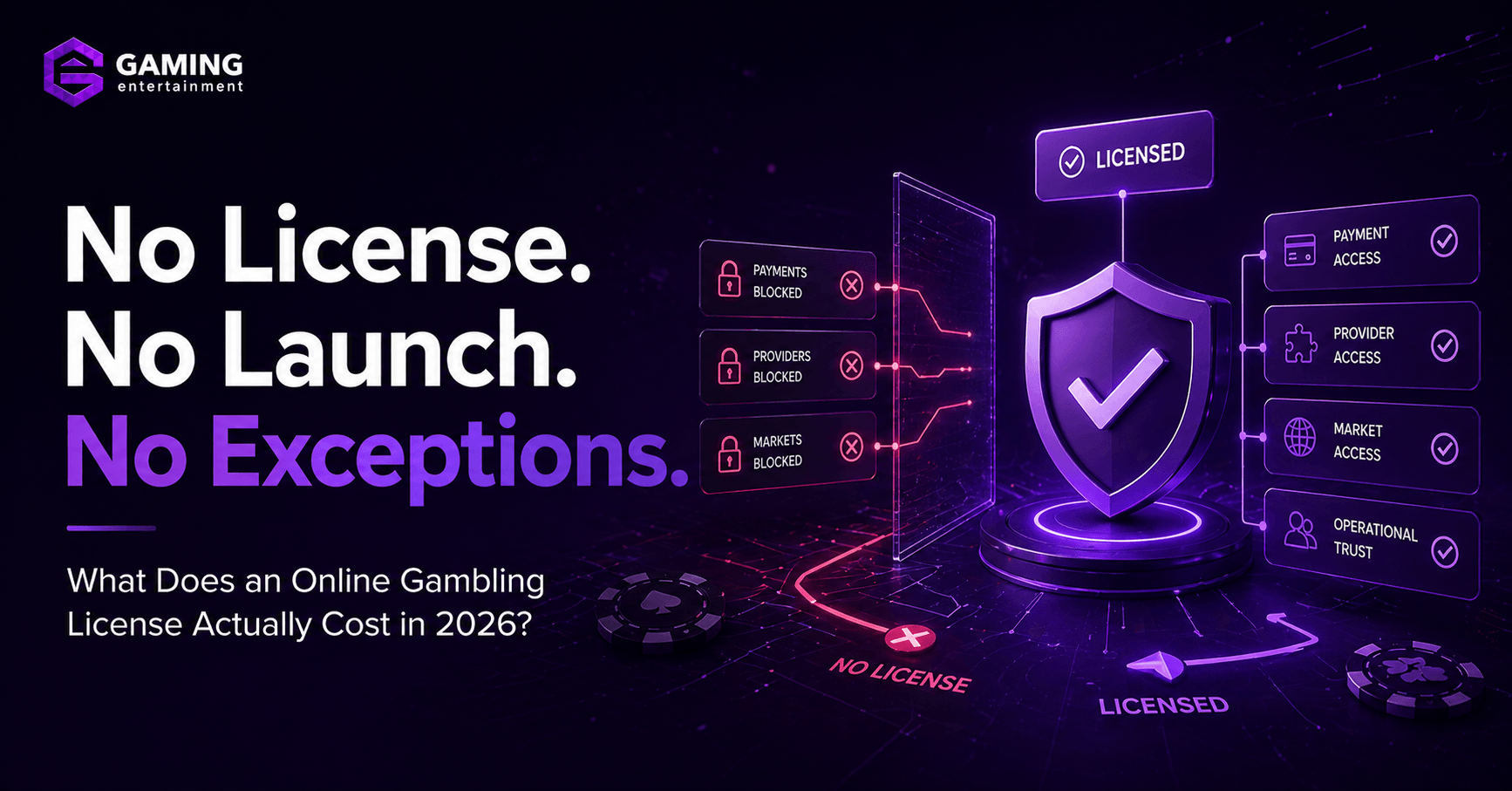
In iGaming, one rule sits above all the others: no license, no launch.
A polished casino site and a deep game portfolio mean little without regulatory approval. A gaming license isn’t just paperwork - it’s the credential that opens doors to payment providers and banking partners, allows integration with reputable game studios, enables legal operation in regulated markets, and builds the legitimacy that earns player trust from day one. Tier-one game providers won’t contract with unlicensed operators, banks decline accounts, and affiliate networks simply won’t onboard you.
Most new operators underestimate the complexity until they’re already deep in documentation, audit fees, and due diligence. That’s why understanding the full cost of licensing - not just the headline application fee - is essential for both compliance and effective budgeting.
When you work with Gaming Entertainment, you get something most providers don’t offer in one place: licensing guidance, a fully integrated casino platform, and compliance-ready CRM and KYC tools under one roof. That means less guesswork, fewer vendor handoffs, and a faster path to launch.
Why the License Comes Before Everything Else
Before the marketing brief, VIP program, or launch campaign, the license is what makes the business real. A valid gambling license builds legitimacy with players, partners, and regulators. It opens the door to tier-one game providers, who will not contract with unlicensed operators. It allows you to properly integrate payment methods and banking services, and to enter regulated markets with confidence rather than resorting to workarounds.
Fortuna is built around that reality from day one. Its architecture comes with compliance-ready features: automated KYC workflows, risk scoring, fraud detection, and reporting dashboards aligned with what regulators actually request during audits.
Licensing Jurisdictions and 2026 Cost Ranges
Each jurisdiction comes with its own trade-offs between speed, credibility, market access, and cost. The figures below reflect 2026 government fees and are working ranges only - final numbers shift depending on corporate structure, share capital requirements, audit scope, and local representation obligations. Costs in EUR/GBP are official; USD approximations are provided.
Curaçao now sits as a mid-tier option rather than the entry-level choice it once was. The jurisdiction completed a fundamental reform in late 2024 under the new National Ordinance on Games of Chance (LOK), which abolished the old master license and sub-license system entirely. Licenses are now issued directly by the Curaçao Gaming Authority. The application fee runs €4,592, with annual costs of €47,450 covering the combined license fee and supervisory contribution. Curaçao remains crypto-friendly and offers a broad market reach, but the cost structure has roughly tripled compared to the legacy model. The upside is that international banks and payment processors take licenses more seriously than they used to.
Malta, through the MGA, remains the EU credibility benchmark. It's the jurisdiction of choice for operators targeting European markets where banking trust and payment processor relationships are decisive. The application fee is €5,000, with fixed annual fees of €25,000 for B2C Type 1-3 licenses or €10,000 for Type 4. On top of that, there is a variable compliance contribution starting at €15,000 and scaling with revenue, plus a €100,000 minimum share capital requirement for Type 1, and a 5% gaming tax on revenue from Maltese-based players. Malta is more expensive and more demanding than the alternatives, but it earns its premium in market access.
The Isle of Man, regulated by the GSC, offers tier-one credibility alongside an attractive tax framework — 0% corporate tax on gaming profits and a tiered gaming duty ranging from 0.1% to 1.5% of GGY. The application fee sits at £5,250, with full OGRA annual fees of £36,750 (or £52,500 for the Network Services license). Two resident directors and a local Designated Official are required, which adds to the cost base but signals the jurisdiction's seriousness.
Anjouan offers the fastest path to market - typically two to six weeks - and the lowest entry cost at roughly €17,828 annually for the licensing package, plus €2,000 per key person authorisation and €500 for each domain beyond the first two. There's no tax on GGR. The tradeoff is real, though: acceptance from banking and payment service providers is more selective than with mid-tier or premium licenses, which can create operational friction as the platform scales.
Fortuna supports operators across all four jurisdictions, handling corporate setup, licensing guidance, legal bridging, and platform deployment as a single track of work - not four separate vendor relationships.
What Actually Drives the Total Cost
Operators often budget for the headline license fee, only to be surprised by everything else. The real cost stack has three layers:
Upfront costs cover legal entity formation and corporate structuring, the license application and submission fees themselves, technical audits and platform certification with accredited test labs, and any share capital deposits the jurisdiction requires - for example, Malta starts at €100,000 for Type 1.
Ongoing costs include annual renewal and supervisory fees, local representation where the jurisdiction requires it - for example, both Curaçao and the Isle of Man require resident directors - AML and KYC reporting cycles, periodic audits, and compliance contributions or gaming duties tied to revenue.
Operational costs are where most underestimates happen. KYC and AML provider integrations carry their own price tags. Payment provider onboarding brings its own due diligence costs and is often the slowest part of going live. Domain and content compliance can vary by market. And banking access - sometimes the hidden cost driver - varies dramatically across jurisdictions, which is why two operators with similar license fees can end up with very different total operating costs.
This is where Fortuna truly changes the equation. Because the platform is audit-ready and ships with built-in CRM, bonus engine, and fraud prevention, operators avoid the cost and timeline of stitching together five or six separate vendor stacks just to get to launch.
Why Fortuna Pairs Well With the Licensing Process
The platform was designed with regulatory submissions in mind, meaning the features that matter for licensing are already built in rather than bolted on later. Built-in KYC and AML automation accelerates compliance approval. The real-time risk and fraud engine reduces chargeback and bonus abuse exposure, which matters to both regulators and payment processors during onboarding. Because CRM, segmentation, and the bonus engine all sit on a single stack, operators avoid the additional licensing and integration costs of running them as separate systems. Multi-wallet and payment integration streamlines due diligence with payment institutions, and the analytics and reporting dashboards produce clean audit logs that regulators expect during reviews.
In practice, operators running on Fortuna reach launch noticeably faster than those piecing together multiple vendors and trying to make them work together.
The Real Cost of Cutting Corners
Operating without a license isn’t a shortcut - it’s a self-inflicted problem that surfaces at the worst possible moment. The pattern is consistent across operators who try it: frozen payment accounts, game provider contracts refused or revoked, regulatory penalties and reputational damage, and eventually a forced shutdown that wipes out everything that came before. The operators still in business five years from now will be the ones who treated licensing as a foundation, not just a checklist item.
Build a Licensed Operation, Not a Compliance Headache
When you work with Gaming Entertainment, you get licensing support from a team that has been through the process across multiple jurisdictions, a complete casino backend and game library, CRM, bonus engine and fraud controls running on a single stack, and a ready-to-launch setup - not just a project plan.
Ready to launch legally and on a realistic timeline? Get in touch at [email protected] to book a demo.